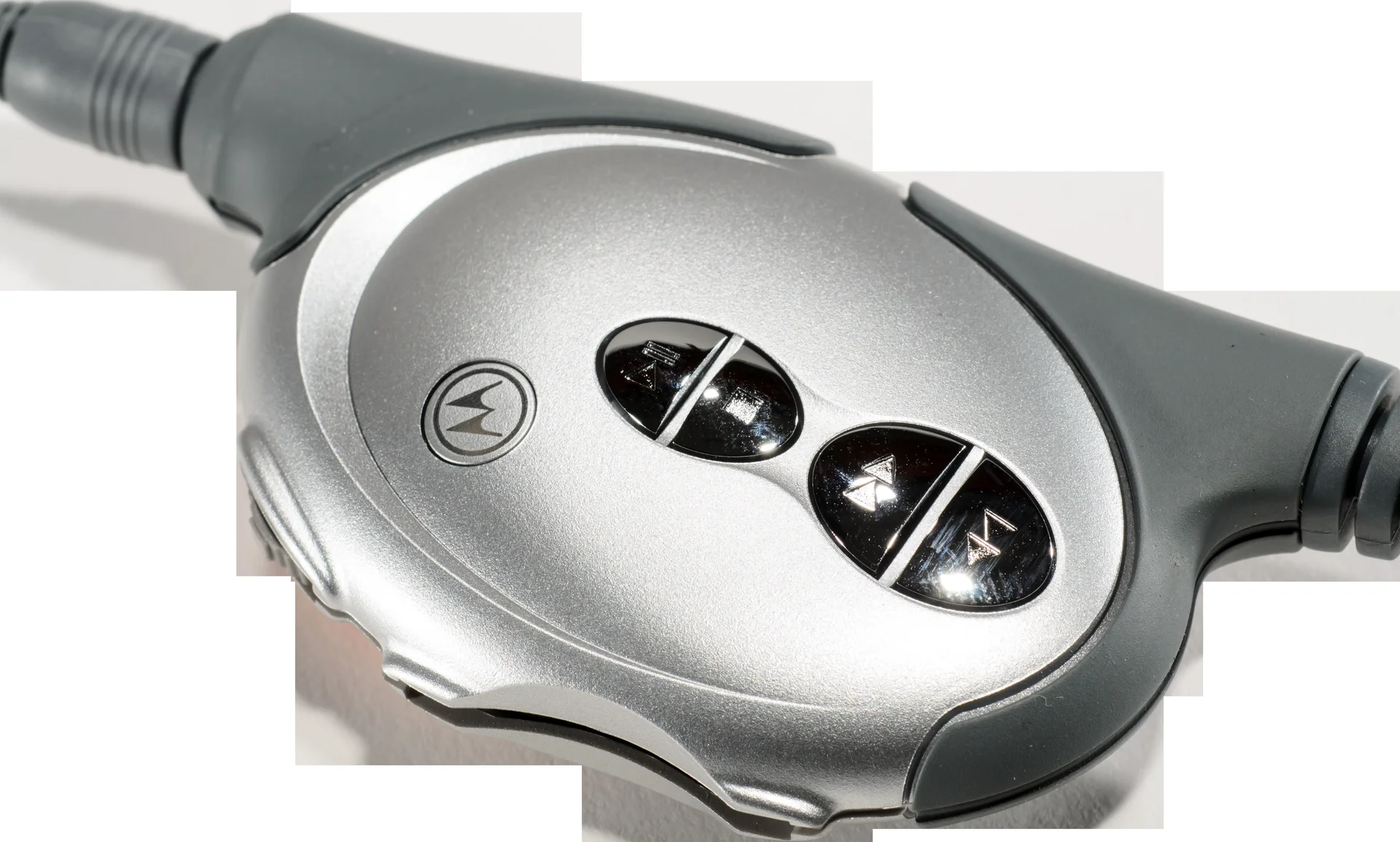
Motorola MP600 (Typan) Forensic Report
I. Project Summary
- Role: Lead Product Architect / Mechanical Liaison (Solteras / Mechanistic division).
- Mandate: Engineer a “tie clip” MP3 player accessory for Motorola’s V.dot brand — a lightweight, battery-less device powered by the host phone through a 17-pin interface, with SD/MMC storage and USB transfer.
- Core Achievement: Delivered the mechanical design and manufacturing support for the 2002 CES Innovations Honoree, integrating a 17-pin phone interface, custom switch architecture, and removable storage into a sub-miniature wearable envelope on a sub-three-month design cycle.
II. The Anatomy of Failure
1. Thermal Crisis: Housing Transformation
- Trigger: Temperature-shock testing exposed a confirmed risk of housing “transformation” — catastrophic warping. The aggressive thin-wall strategy used to clear internal components could not survive thermal cycling, and the cover was too thin to even mold reliably.
- Intervention: Reversed to a maximum-material-condition directive (“Need the thickness to be Maximum as much as can be”), applied a mandatory 0.4 mm increase to the cover to make injection viable, and normalized the partline reveal to a constant cross-section so the shell cooled and expanded uniformly.
- Result: The housing survived environmental qualification — at the price of internal clearance, which had to be re-won elsewhere.
2. Geometric Crisis: The Sub-Miniature Squeeze
- Trigger: The “square version” diagnostic prototypes revealed stacked interferences: the belt-clip mounting point sat on the MMC connector centerline, the switch housing collided with the secondary PCB with undefined clearance, wall thickness varied wildly around the headphone jack, and the volume wheel and logo lens crowded the pole.
- Intervention: Surgical component migration — moved the PCB-to-PCB connector right to clear the clip centerline, forced definition of PCB keep-outs and a board-size reduction, engineered “Rib 1” to lock the floating audio jack in the Z/Y axes, and switched the jack area to slide-core extraction for clean mold release.
- Result: Five-plus critical interferences resolved through direct CAD intervention; the assembly closed.
3. Component Crisis: The Switch That Didn’t Exist
- Trigger: The electrical specification demanded a Normally Closed switch, but every available N.C. part was too large for the tie-clip envelope — only Normally Open switches came small enough. Compounding it, the compressed vertical stack left the buttons with limited travel.
- Intervention: Commissioned ITT Cannon to invert an existing sub-miniature N.O. chassis to N.C. logic while holding its original dimensions. Shifted switch placement laterally to optimize the actuation vector, refined the button skirt surfaces to prevent binding, and enforced an explicit clearance between switch housing and PCB2 so the mechanism wasn’t pre-loaded at rest.
- Result: N.C. behavior inside an N.O. footprint — electrical logic and industrial design both satisfied.
4. Shock Crisis: The 17-Pin Hard Path
- Trigger: Drop diagnostics flagged the rigid 17-pin connector as a piston driving impact force directly into the PCB (“Concerned about Conn transmitting forces directly to PCB when unit is dropped”), and the cord strain relief was failing side-pull tests instead of absorbing energy.
- Intervention: Redesigned the cord interface zone — grew the cord area for the larger diameter, decoupled the external cable loads from the internal SDMC connector, and used clearance-defined crumple space so the connector could not bottom out against the board.
- Result: Shock path broken; the tethered wearable survived the drop regime its use case guaranteed.
5. Tooling Crisis: Die Locks and Metrology
- Trigger: The “Rib 5 snap” geometry was physically impossible to mold in one shot (“RIB 5 snap cannot be together” — a die-lock condition), ultrasonic welding was ruled out for lack of space, and the headphone plug’s critical insertion depth could not be verified with standard tools.
- Intervention: Moved the rib to a post-tooling operation with a reinforcing bridge at the snap root. For metrology, the manufacturing partner Shinwoo Audio built a custom adaptor/criterion jig on Mitutoyo dial gauges, re-calibrated from 10.9 mm to an 11.3 mm reference to strictly guarantee the critical C-dimension above 10.55 mm, with microscope inspection as the borderline failsafe.
- Result: A stable tool, a guaranteed connector seat, and a clean hand-off — the assembly transferred to Shinwoo “very complete and robust.”
III. Governance & Rhythm
- The Pulse: Driven under a consultant agreement between Solteras and Motorola, governed by high-frequency facsimile exchanges with the Seoul manufacturing partner and granular BOM revisions (Rev 8.0) tracking 23-week lead times on the Micronas decoder to prevent line-down scenarios.
- The Artifacts: The September 2000 BOM; the fax corpus carrying the hand-sketched tooling corrections; the concept sheet defining the V.dot strategy; the July 2000 proposal defining the Mechanistic scope.
IV. Quantified Impact
- Secured 2002 CES Innovations Honoree status for the V.dot MP3 player accessory.
- Delivered a battery-less, phone-powered architecture — the volumetric win that made the tie-clip form factor possible.
- Managed a 61+ line-item BOM including the Micronas MAS3509A decoder and Microchip PIC16F877.
- Integrated 32 MB SD/MMC removable storage and USB transfer into a sub-miniature wearable envelope.
- Resolved five-plus critical mechanical interferences via direct CAD intervention.
- Directed the manufacturing hand-off to Shinwoo Audio with a design robust enough to absorb final tooling modification.
- Executed the design cycle in under three months.
V. Source Trail
The claims above rest on the project’s primary evidence archive — faxed tooling markups, BOMs, and vendor correspondence — compiled through the NotebookLM forensic registry:
MP600_faxes.pdf— the hand-sketched tooling corrections, thermal warnings, and the “RIB 5 snap cannot be together” / “Add Bridge” markups.MP3 BOM9.26.00— component selection and cost basis, including the critical silicon.MP3 Concept Sheet.pdf— the V.dot brand strategy and market positioning.mp3_proposal_07_26_00.pdf— the contractual scope and the Mechanistic role.20_mp3.txt— the CES Innovations Honoree citation.