C|24
I. Project Summary
I owned the mechanical engineering and industrial-design implementation of Digidesign’s C|24, from the early surface and packaging work through tooling, build support and production release. The job was to turn a large, familiar control surface into a lower-profile product while preserving the feel and accessibility of a real mixing console.
The business brief was specific: replace the Control|24 with a RoHS-compliant product, package sixteen Digidesign preamps in place of the licensed design, support 5.1 monitoring, and fit within a 43-inch maximum width. Removing the approximately $200 royalty was a program objective. My responsibility was the physical product that made those changes possible: surfaces, molded parts, fabricated chassis, board interfaces, controls, artwork and the instructions suppliers needed to build and inspect them.
II. The Product That Shipped
The C|24 put twenty-four motorized faders, sixteen preamps, a stereo submixer and surround-monitor controls into one low-profile console. Most analog connections moved to DB25 connectors. Three two-row LCDs replaced the predecessor’s short channel readouts, and the control layout consolidated functions that had occupied dedicated buttons. The product and hardware teams defined the feature set; I developed and integrated its physical implementation.
The layout was worked through on a physical mock-up. Notes circulated after the February 24, 2006 review record moving the transport controls during the meeting; by March 3, I had RC2, also called Revision 1.0, on the foamcore mock-up for signatures. The exchange separates completed layout edits from preliminary graphics and the planned work with Neal Breitbarth and New Deal. It records the request for signoff, without establishing that the signatures were collected.
That integration reached below the visible surface. The March 2006 construction-review email records my solution for getting the meter boards inside the sheet-metal enclosure while preserving the plastic design I wanted. Once that packaging problem was resolved, I redirected the review time toward releasing the Data Control Drawings that the PCB designers needed. Surface development and electrical packaging advanced together.
I also designed and built the new two-encoder surround-panning interface: an X/Y control that let an engineer position a sound across a 5.1 field by feel. The side caps, gills, meter windows, jog-wheel surround and front bolster gave that dense control layout a continuous exterior. Their appearance depended on the geometry and assembly underneath them.
Origin Story


III. Design and Production
1. Paint Curing and Side-Cap Fit
The long ABS side caps exposed the interaction between molding, paint curing and assembly fit. Jetcrown’s comparison shows the original unsupported baking arrangement, an attempted three-support fixture that still allowed twisting, and Method A, which held the parts vertically to reduce deformation. I worked the problem through the supplier’s process and the mating geometry.
The July 5 inspection table shows why the diagnosis mattered. One left-side-cap sample lost 1.04 mm in length through painting, from 755.28 to 754.24 mm, ending 2.27 mm below the lower drawing limit. The same inspection tracked flatness separately. Cure support could address deformation, while the part’s final size and mating geometry still needed their own decisions.
I released the plastics for production through ECO 12740, including mechanical changes to both side caps. Supplier process work continued alongside the part revisions. Getting the plastics into production also required agreement on which dimensions controlled fit and which could be relaxed.
Side Cap Crisis


2. Recovering Top-Panel Fabrication
The main panel combined large fabricated surfaces with densely placed welded hardware. By March 7, 2007, the status report recorded Kwanta’s no-bid and an active Operations and Manufacturing response. The April report identified Mass Precision and Kenny as bridge options within the VTech manufacturing program.
I worked with Mass Precision on manual offset-welded parts and supported the overseas fabrication path while welding capability and panel quality were being resolved. The geometry still had to work at the factory: access for the welding head, placement of the studs, countersinks, bend quality and the cosmetic surface all belonged to the same part.
The prototype samples made those constraints tangible. On January 24, Ed Stegall reported that unpainted top surfaces had reached Menlo Park the previous day. The close hardware placement had required an offset welder and tooling. He separately reported that the units then in the paint shop had missed a manual countersink operation and were returning to prototype work; the painted and silkscreened versions were to include it. I said the temporary state was fine for the immediate work and asked for a quick drawing detail. The unpainted sheet-metal delivery was separate from the CNC plastic prototypes.
The bend geometry needed equally specific decisions. In a March 13 exchange, I allowed reliefs and asked for their dimensions so I could update the model. Mass Precision’s Fidel Saucedo identified an obround slot too close to a bend, and I asked to shorten it to increase the edge clearance from 0.118 to 0.174 inch. He acknowledged the change and returned the marked detail. The attached Revision 5 drawing also defines the countersinks and allowable distortion. These records show the drawing and fabrication direction being worked through; they do not establish the inspection result for a finished lot.
I fully ruptured my Achilles during this period. After returning from the hospital, I sent the weld-stud files from the hotel so fabrication could continue. The work progressed, but the later lessons-learned report also records the cost of working outside the normal file-control system: an incongruent revision reached the manufacturer.
Manufacturing Wins


3. A Quiet, Low-Profile Console
The C|24 requirements explicitly prohibited a fan because the console sits at the mix engineer’s listening position. They also specified an external power supply, replacing the Control|24’s internal supply. Moving power conversion outside the console and consolidating the rear-panel connections helped make the lower-profile enclosure possible.
The specified operating environment was 10–35 °C. Cooling and packaging had to work within that requirement while keeping the listening position quiet.
4. A Field-Replaceable Headphone Jack
The proposed front jack location put the headphone plug where it could be struck, while the original assembly made replacement unnecessarily invasive. Arndt Hufenbach and Manufacturing pushed for service access, and I developed the mechanical response.
The first recessed-bolster mock-up did not settle the matter. In April, product management rejected it because different headphone-plug overmolds made the recess awkward to use. Several PMs remained strongly opposed to a replaceable jack. Arndt, Manufacturing and I continued pressing the issue, and I designed the field-replaceable unit that ultimately shipped.
The July mounting-change form and the earlier rejected mock-up describe different stages of that work. The engineering lesson is the negotiation between access, protection, appearance and serviceability, carried through to a physical solution.
5. Board-to-Mechanical Interfaces
I controlled C|24 board interfaces through Data Control Drawings. The June register lists 19 distinct PCBA designs; the MicPre8 I/O drawing records 12 revisions.
I used Data Control Drawings to make those interfaces explicit: board outlines, mounting holes, component locations and clearances that electrical layout had to respect. The MicPre8 I/O drawing reached revision 12. Its revision table records changes to mounting holes, headers, connector spacing and the board outline, with my name against the revisions. The point was to resolve those changes against the assembly while the design was still editable.
The drawings also show interfaces being coordinated across boards. In August 2006, the Auto C revision table records moving J1 and J2, then relocating headers, to match the Submix I/O board. The Submix drawing from the same month records a power-connector move and a 25 mm extension of the board outline. Those linked revisions make the coordination concrete: the connector locations and board envelopes were changing together. They document design changes, without establishing a completed fit test or a production outcome.
The drawing releases gave PCB layout and mechanical tooling a common set of interfaces as both designs evolved.
6. Power-Supply Certification
The external supply created a separate release dependency. The July status report planned to hand-pack the first hundred supplies and apply UL labels at Menlo Park, while a later enclosure variant remained subject to thermal work.
Engineering worked with UL to start system and supply certification in parallel. The post-project lessons identify that as a successful change to the NPI process. Mechanical release, hardware validation, certification and the final pack-out had to converge for shipment.
7. Controls and Molded-Part Geometry
The smaller Bourns EM14 encoder needed its own mechanical integration. I designed the jog-wheel support and surround so the component, knob and adjacent surface worked as an assembly. ECO 13082 records the bracket release. ECO 13526 later relaxes its mounting-hole tolerance to ±0.05 mm at the vendor’s request, making the drawing compatible with the fabrication process.
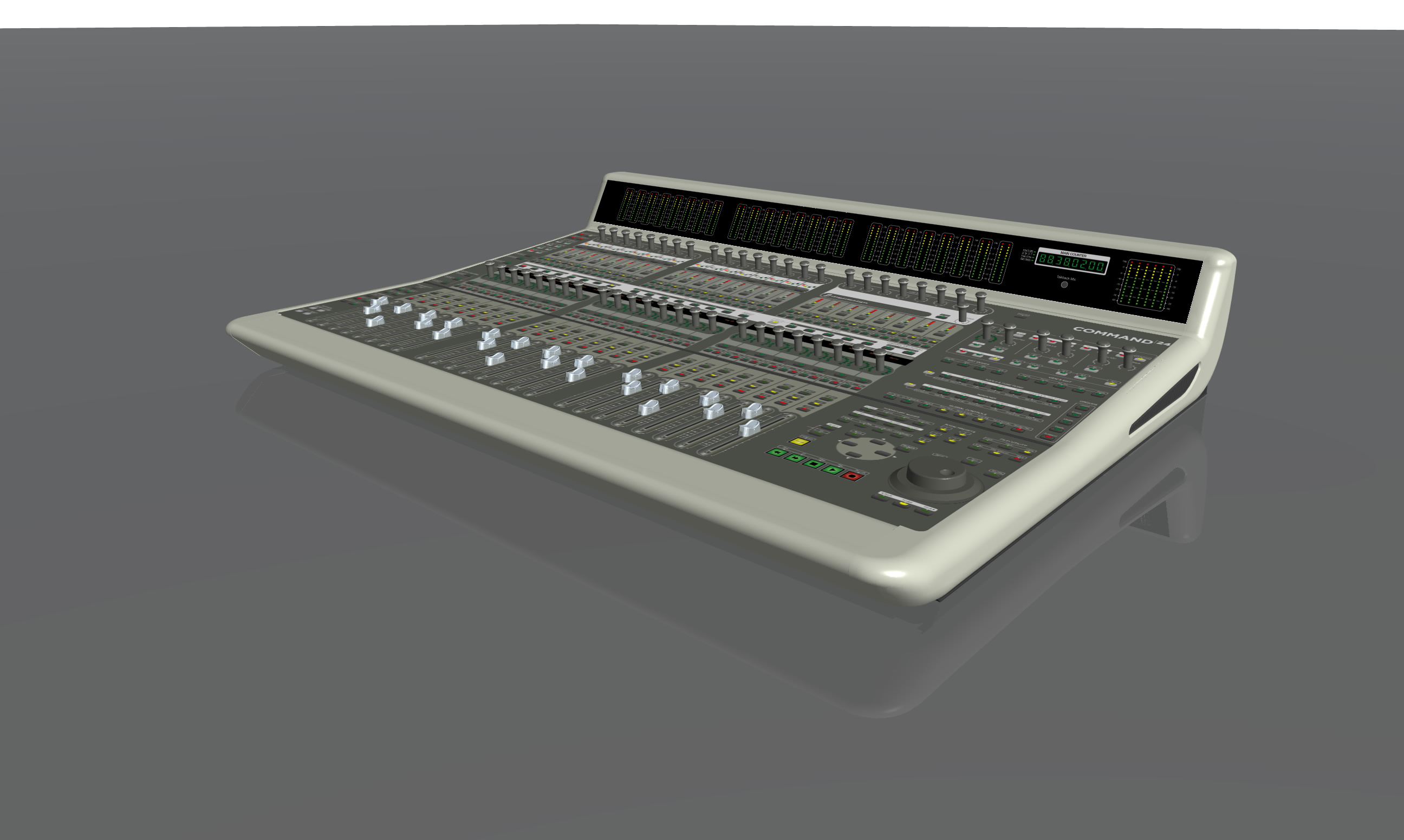
Surface development also continued through explicit intermediate states. On December 7, 2006, I sent a preliminary side cap that was still unshelled and needed its meter-bridge top loft completed. The next day I sent Neal left and right side caps and gill inserts, with transitions still to refine. Neal then circulated an updated rendering, crediting my side-plastic changes while keeping the outside color open for further discussion.
Color and finish were separate engineering decisions. On December 20, 2006, Neal Breitbarth specified Spectral Master DS-022 for the outside plastics and asked for low gloss; I followed up about the gill color and Mold-Tech texture. My prototype instructions later that day assigned DS-022 to the side caps, bolster and meter pieces, Pantone Cool Gray 6 U to the gills, and MT-11020 texture with low gloss to all seven parts. The retained color register separates plastic-color specifications from paint specifications for plastic and sheet metal. These records do not establish that DS-022 and the proposed rubberized paint were the same coating.
The August 2007 definition made the color measurable. Specification 9470-58162-00, written by Rich Hackett and completed by Fil Labson, set a maximum Delta E of 1.5 against a named master paint chip under specified measurement conditions. The actual Rev E side-cap drawings call up that paint specification and MT-11000 texture; ECO 13105 records the corresponding part and tooling revisions. The retained specification is marked DRAFT, and the ECO approval fields are blank. Together they document the intended finish and its drawing references, without establishing an approved production batch.
The prototype process also needed a decision. I initially requested SLA parts prepared, primed and painted. Solid Concepts’ Emran Mursalin warned that the large parts could accumulate enough SLA variation to compromise their fit and proposed CNC machining. I preferred CNC, while leaving the final choice to Neal and Terri Merrell. Neal made that choice conditional on receiving parts by January 20. The revised December 21 quotation specified seven painted ABS CNC parts and four clear-stock CNC parts, with delivery quoted for January 20 or sooner. Solid Concepts confirmed the matching order and PO on December 22 and reported shipping the same eleven part names on January 12. That connects the process decision to an order and a supplier dispatch report; the examined record still does not establish the date of customer receipt or an accepted fit result.
The gills required careful surface development and dimensional inspection against the side caps. The molded parts also brought short shots, drag, sinks, gate placement and interference around the faders. The June issue list separates completed corrections from open questions and temporary trim-to-fit measures. In sustaining work, I also supported foam sealing around the meter-lens area to address dust ingress.
The attachment definitions changed too. Early side-cap bills of material list Plastite screws and L brackets; their Revision 2 definitions retain the molded cap and insert but specify captive M3 spring nuts. The front-bolster lists also change one standoff group from 20 mm to 10 mm. Those are concrete changes in the documented configuration, but the sheets do not date approval or establish a causal link to the later paint-fit correction.
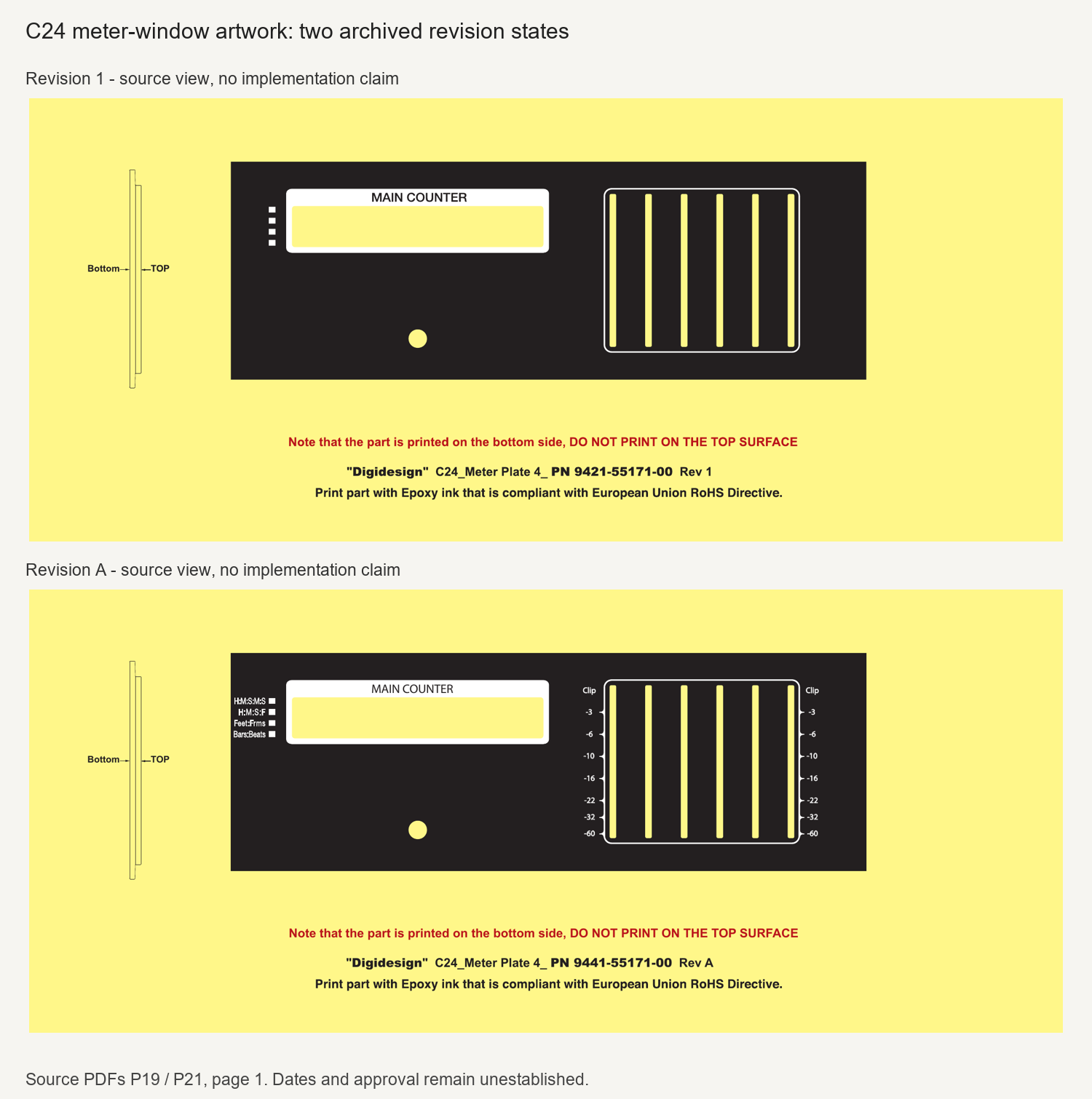
The manufacturing artwork was part of that physical definition. The meter-window sheets specify white ink in the first pass and black ink in the second, both on the underside, using RoHS-compliant epoxy ink. The main-counter files also expose a document-control mismatch: the Revision 1 white-ink separation already includes the time-format labels, but its combined PART view omits them. The examined Revision A views include the meter scales absent from those Revision 1 views. These archived sheets do not establish when a change was approved or reached production.
The graphics work was collaborative. Neal Breitbarth circulated the rear-panel artwork; Robin Parnaby specified the connector labels and Lev Perrey commented on alignment, with me copied on the review. In an April review, Matt Peterson flagged input labels in the rendering he had, and Neal supplied a different master he described as signed off. Keeping the artwork revision aligned with the mechanical definition mattered as much as the appearance of the individual sheet.
Structural Components


The meter-window artwork states
Archived combined PART views for the C24 main-counter meter window. Revision 1 is labelled PN 9421-55171-00; the selected Revision A is labelled PN 9441-55171-00. The numbering discrepancy is unresolved. Time-format labels and meter scales are absent from this Revision 1 PART view, but its separate white-ink sheet already contains the time-format labels. The comparison therefore does not date their introduction. Both PART views specify underside printing; approval and production dates remain unestablished.
Side-plastic development, December 2006
Development rendering circulated by Neal Breitbarth on December 9, 2006. He credited Erik Norris with the revised side plastics; the outside-plastic color was still under discussion. This is a design rendering, not a photograph of a built unit.
IV. Production Acceptance and Release
I carried the mechanical model through supplier files, drawing releases, inspection and assembly feedback. The record includes the plastics and artwork, the sheet-metal structure, small controls and light-management parts, and the changes needed after those pieces met on the line. The work extended into sustaining changes after First Customer Ship.
The supplier handoff had its own revision problems before production. In October 2006, while sharing preliminary sheet-metal files, I said the next release would be for prototypes and that drawings were still incomplete. In December, Mass Precision found Revision 1 PDFs beside Revision 2 models. I confirmed that the models were correct and asked Nina Dovlatova to update the PDFs; I also explained that the earlier Revision 1 parts had never been built and Revision 2 parts were then being built. That exchange records the correction request and file check-in. A later December 13 supplier message carries readable Revision 2 manufacturing PDFs for both top-panel parts, with hardware corrections and feedback about welding access near bends. That transmission establishes the later drawing endpoint; it does not itself establish approval of every supplier correction or completed parts.
Artwork exposed another release detail. The January artwork sheet still used a placeholder for the light-gray ink color. When I supplied a gray specification in February, Mass Precision pointed out that it defined the paint, not the missing silkscreen color. A subsequent message scheduled the parts for delivery after paint and artwork clarification; it did not record the final ink choice or customer receipt.
Inspection criteria were part of that engineering responsibility. In November I originated deviation DEV00118 to remove noncritical dimensions and increase selected tolerances, with acceptance tied to named Jetcrown inspection reports. It covered side caps, the bolster, meter parts and gills. The decision preserved what controlled fit and function and made acceptable production variation explicit.
The lessons-learned record is candid about the broader launch. It credits meeting Q4 FQA and revenue targets and getting costs below the Phase 1 target. It also records revision confusion, late board changes, cosmetic quality problems and inadequate spare-parts coverage. Mechanical control had to include the files, the supplier’s understanding and the inspection decision, as well as the CAD.
Paper Trail


Press Resources


V. Results
- Product mandate: twenty-four faders, sixteen preamps and a 43-inch maximum width; removal of the approximately $200 licensed-design royalty.
- Mechanical integration: nineteen distinct PCBA designs in the June build register; twelve documented revisions of the MicPre8 I/O drawing.
- Serviceability: a field-replaceable headphone-jack assembly, developed despite resistance to changing the original design.
- Manufacturing: a manual-fabrication bridge, documented cure-support alternatives and explicit acceptance criteria for production plastics.
- Delivery: First Customer Ship on November 7, 2007. The project retrospective records that the Q4 FQA and revenue targets were achieved.
The July financial plan estimated a 51.8% gross margin at an $8,995 suggested retail price. The later product-master approval set the price at $9,995.
Sustaining the inspection definition
The work continued after shipment. A December change form I originated identifies unclear supplier inspection criteria and calls for redimensioned drawings, added tolerances and clearer inspection instructions. Its accompanying side-cap revision records a drawing change; neither the form nor the marked-up drawings establish that every proposed change had completed approval and production implementation. The supported result is a continuing effort to make the factory inspection match the parts and their interfaces.
The working markups make those inspection questions concrete. They ask which dimensions matter when a lens is over-dimensioned, where a meter-top drawing needs additional dimensions, and whether a difficult-to-measure gill dimension is useful after tooling. Several lens sheets also question missing revision-history entries. These are review questions recorded on drawings, not evidence that every suggested change was approved or implemented.
C|24 delivery chronology
DCD release sequence
Seven primary email checkpoints document 18 unique PCB DCD identifiers from April 18 through June 27, 2006.
7 checkpoints · 18 identifiers
-
Kickoff and teardown
The project opened with a request for a nonfunctional Control|24 unit to tear down and study before drawing the replacement.
-
Architecture strategy locked
The surface design and initial requirements were established, with only minor dimensional changes expected rather than a wholesale footprint change.
-
Layout brought to the physical mock-up
After the February 24 layout review, Erik put RC2, also called Revision 1.0, on the foamcore mock-up and requested signatures. The record establishes the mock-up and request, not completed signoff.
Read the project section ↓ -
DCD geometric-control system
The construction review was canceled so the team could release Data Control Drawings as fast as possible and make the PCB-to-chassis interfaces explicit.
-
First verified DCD release packet
Revision 1 geometry was delivered for twelve PCB identifiers.
-
DCD coverage expanded
Four more PCB identifiers entered the release set while four pending interfaces were called out explicitly.
-
DCD revisions advanced
Two remaining boards were added and ten controlled drawings advanced revision while unresolved inputs stayed visible.
-
Eighteen-board DCD index
The release status enumerated current revision levels across 18 unique PCB DCD identifiers.
-
Encoder-board geometry revised
DCD 9150-55153 reached revision 4 after holes were removed and tooling holes moved.
-
Communications-board DCD revised
DCD 9150-55198 advanced to revision 3.
-
Automation-board DCD revised
The Auto A drawing, 9150-55156, reached revision 4.
-
Phase 1 exit delivered
The later delivered-milestone record places Phase 1 exit on October 21, 2006.
-
Domestic fabrication bridge
Mass Precision confirmed corrected revision models and PDFs while the bridge parts were already in process.
-
CNC prototype order confirmed
Solid Concepts confirmed the order for seven painted ABS parts and four clear-stock parts after the SLA-versus-CNC discussion and conditional January 20 deadline. The December 21 quotation and December 22 order are separate states.
Read the project section ↓ -
CNC supplier reported dispatch
Solid Concepts reported shipping the same order, PO and eleven part names. The selected record does not establish customer receipt or accepted fit.
Read the project section ↓ -
Unpainted top-panel samples delivered
Ed Stegall reported that unpainted Mass Precision fit-check top surfaces had reached Menlo Park. He separately described missing countersinks on the units then due and in the paint shop. The unpainted delivery is separate from the CNC plastic order.
Read the project section ↓ -
Top-panel no-bid documented
The March 7 status report records Kwanta's top-panel no-bid and the active Operations/Manufacturing response. By April 4, the matter was before Kwanta's board, with Mass Precision and Kenny identified as bridge options.
March 7 is the earliest located primary report that states the no-bid; it is a reporting checkpoint, not a claimed occurrence date.
Read the project section ↓ -
Relief and slot-clearance direction agreed
Erik permitted reliefs and asked to shorten the slot to increase bend-edge clearance from 0.118 to 0.174 inch; Fidel Saucedo acknowledged the marked direction. The Revision 5 definition is evidence of drawing/fabrication direction, not finished-lot acceptance.
Read the project section ↓ -
Headphone-jack serviceability challenge
Customer Service and Manufacturing challenged the jack replacement path. The April recessed mock-up was rejected; Erik subsequently designed the field-replaceable unit, a later outcome confirmed by his recollection and the July mounting-change form.
The 4.8% and 870 figures in the email describe Digi 002 repairs. The April rejection is distinct from the final field-replaceable design; no exact repair duration is asserted.
Read the project section ↓ -
Proto 3 build opened
The delivered-milestone record places the Proto 3 build start on June 18.
-
Proto 3 build completed
The delivered-milestone record places Proto 3 completion on July 2.
-
Side-cap paint-process inspection
The July 5 table separately records side-cap length, distance outside drawing limits and flatness. A supplier comparison documents vertical Method A; ECO 12740 is a separate plastics production-release form.
Read the project section ↓ -
Release to manufacturing
The delivered-milestone record marks release to manufacturing complete on August 16.
-
Pilot build started
Pilot build started August 20.
-
Pilot build completed
Pilot build completed August 31.
-
Production started
Production start was delivered September 6.
-
At Risk to On Schedule
Status moved from At Risk to On Schedule while the current First Customer Ship plan rebased from October 29 to November 7.
-
First units delivered
The first production units were delivered October 15.
-
First Customer Ship
First Customer Ship was delivered November 7, 2007. November 20 was the original Phase 1 plan, not the delivered milestone.
The final governance schedule explicitly labels November 7 as delivered FCS.
-
Sustaining transition
ECO 13707 was finalized and the team prioritized the next C|24 changes as project work shifted into sustaining support.
The archive filename supplies the historical date; the document's dynamic date field was refreshed in 2025.