
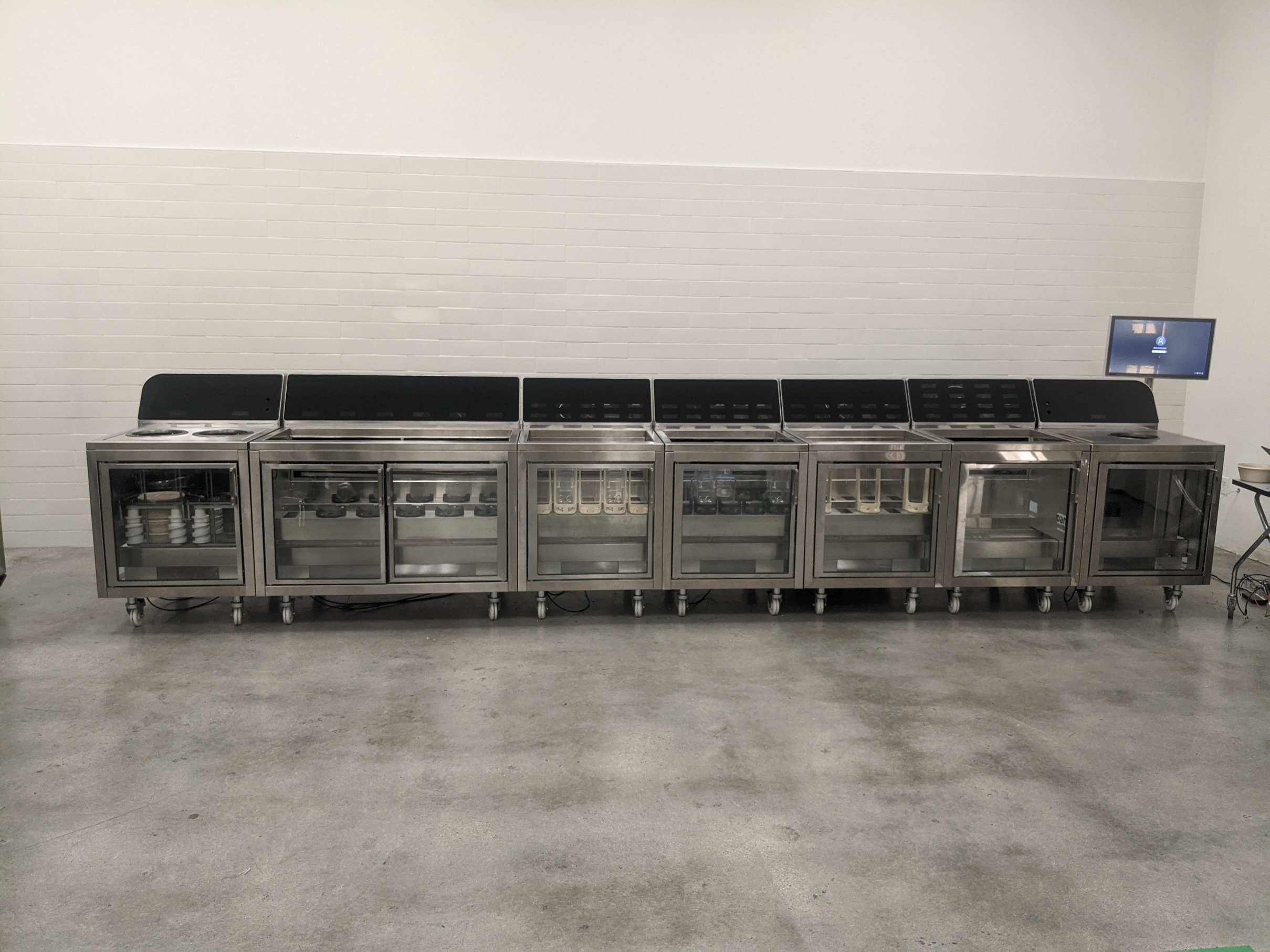
Backsplash / Infrastructure Slot Forensic Report
I. Project Summary
- Role: Senior Mechanical Engineer — the control enclosure and human interface of the Hyphen augmented makeline.
- Mandate: Compress a factory-grade industrial control cabinet into the volumetric footprint of a kitchen splash guard — roughly six inches deep — while surviving commercial washdown and closing the quality loop between the autonomous line below and the human crew above.
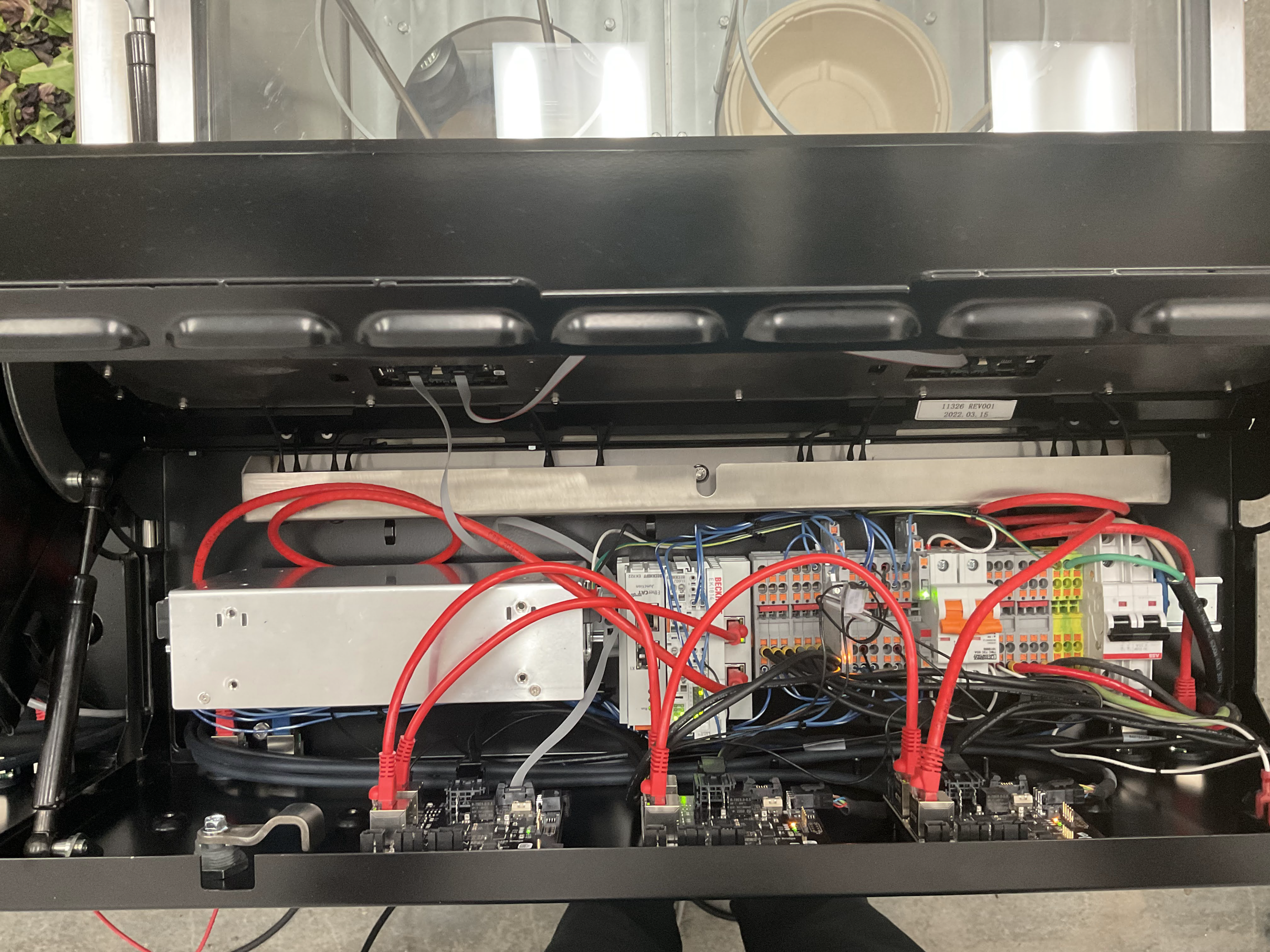
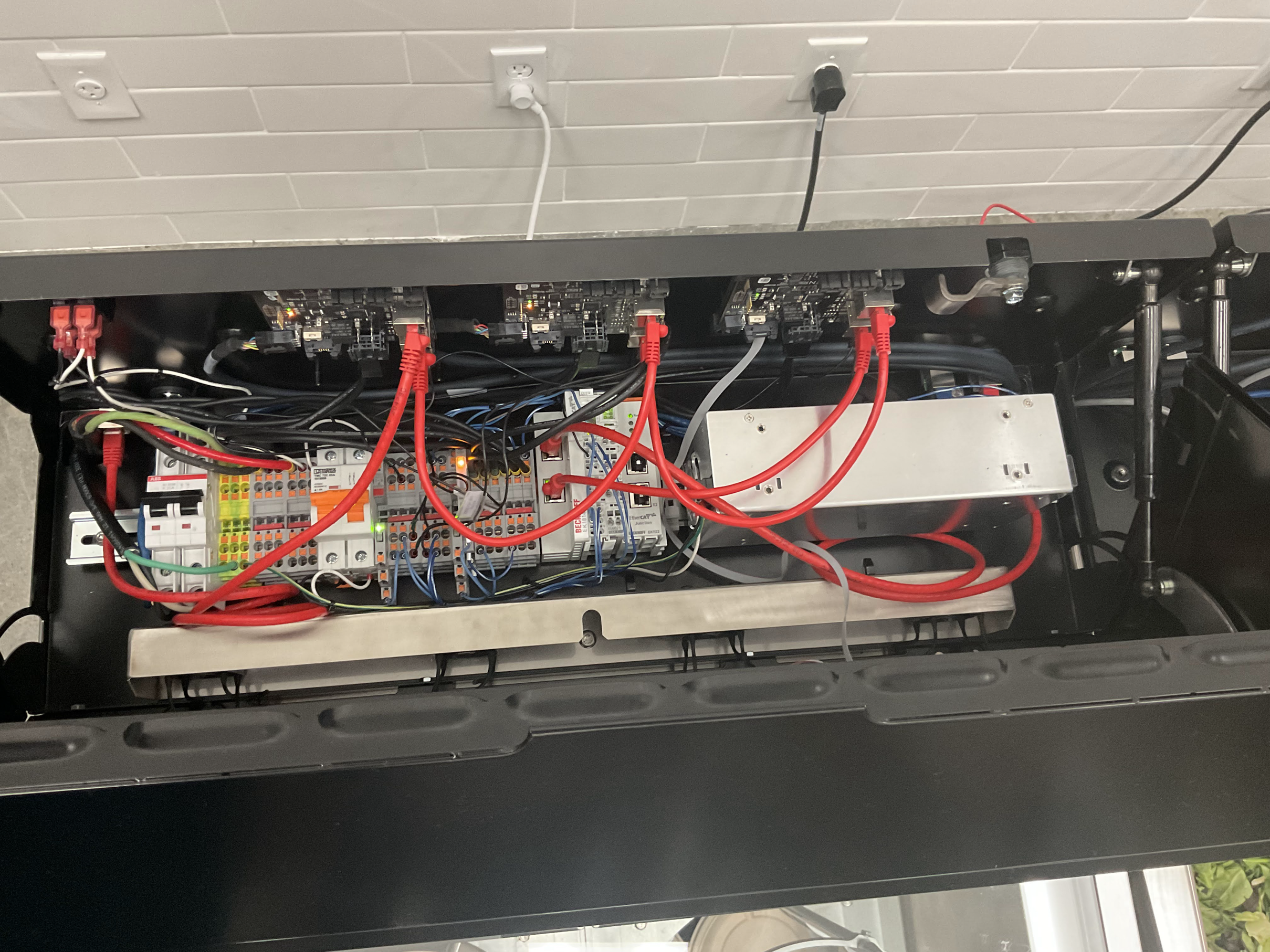
- Core Achievement: The “PC Case” architecture: a custom PCB backplane that replaced the industrial wiring nest entirely, cutting control hardware volume 50% and turning a backsplash into the makeline’s motherboard.
II. The Anatomy of Failure
1. The Volumetric Impossible State
- Trigger: Seventy-plus actuators, power supplies, safety I/O, and cloud-connected control had to live inside a drop-in appliance — and standard industrial electrical cabinets are massive. Early prototypes with traditional wired I/O slices produced an unmanageable wiring nest that choked airflow and made the 15-minute field-service window impossible.
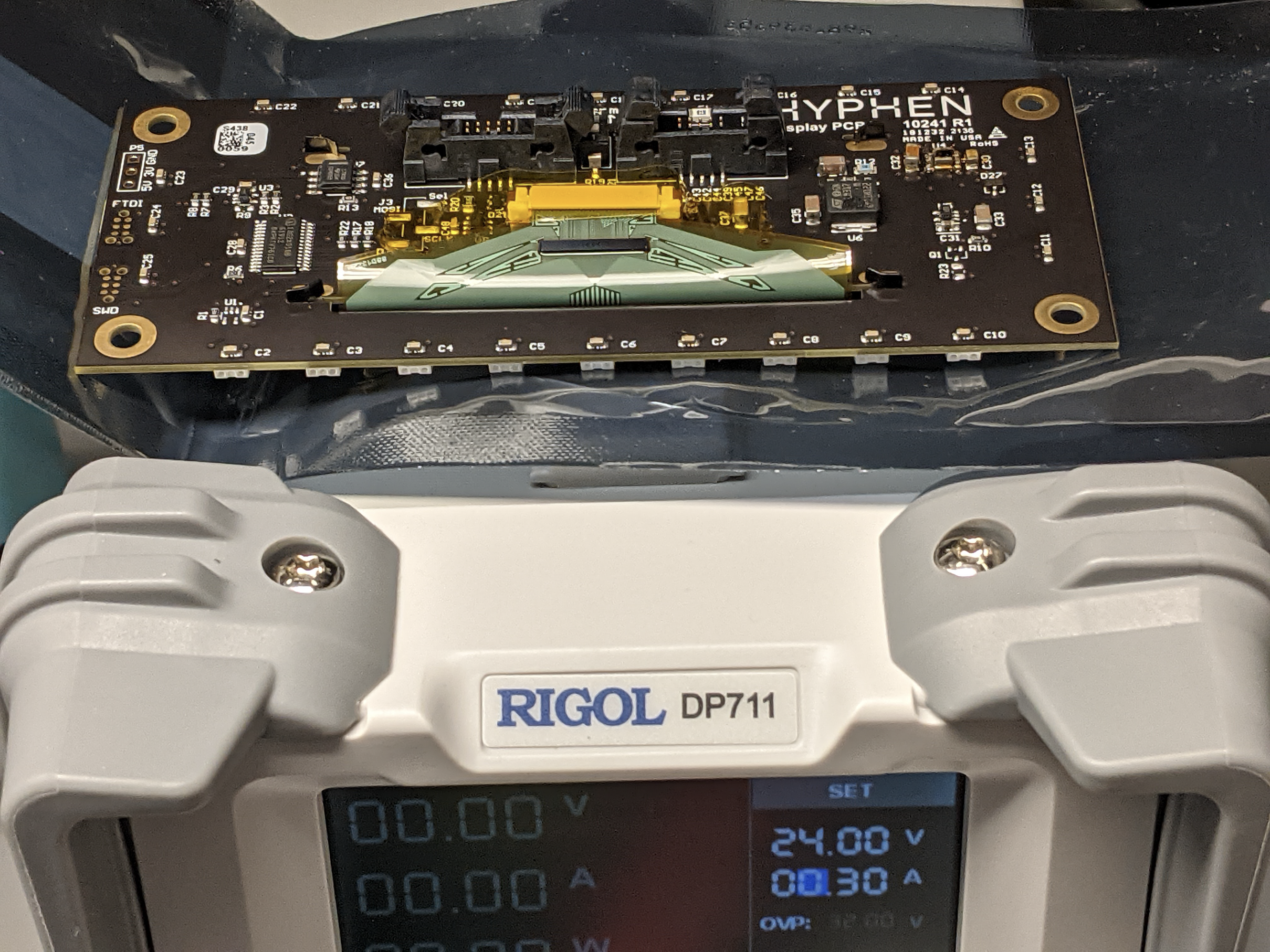
- Intervention: Treated the backsplash as a computer chassis, not sheet metal: a custom signal-distribution PCB accepting Beckhoff EJ-series plug-in modules directly (no hand-wired terminations), with the EtherCAT-RS485 bridge boards (10244R1) deployed as a daisy-chained array — dual IN/OUT ports, on-the-fly frame processing through the EtherCAT slave controller, motor-chain headers distributing both data and 24 V power. A hinged stainless cover gives technicians full under-the-hood access, server-rack style.
- Result: Control hardware volume cut ~50%, discrete wiring harnesses eliminated for 99% of signal distribution, and module swaps in minutes instead of wire-by-wire troubleshooting.
2. Heat in a Six-Inch Slot
- Trigger: Sealed stainless cavity, kitchen-ambient heat outside, electronics dissipation inside, NSF temperature compliance mandatory — and the enclosure must survive high-pressure, high-temperature washdown.
- Intervention: A three-tier strategy: IP69K-rated San Ace fans (washdown-survivable, up to 18.5 CFM) on a directed intake/exhaust path mapped in the patent; 94–95% efficient PULS power supplies selected so only a few watts ever become waste heat; and the wiring-nest elimination doubling as an aerodynamic win — flat PCB distribution leaves the slim cavity an unobstructed air tunnel, thermally decoupled from the hot-food wells below.
- Result: A thermally independent electronics zone holding NSF-compliant temperatures inside the most hostile six inches of a commercial kitchen.
3. The Makelight: Closing the Cobotic Loop
- Trigger: The two-lines-in-one architecture leaves humans doing the high-variance finish work — and human error at 350 meals per hour breaks the system’s 99% accuracy promise. Text-heavy monitors don’t survive a lunch rush.
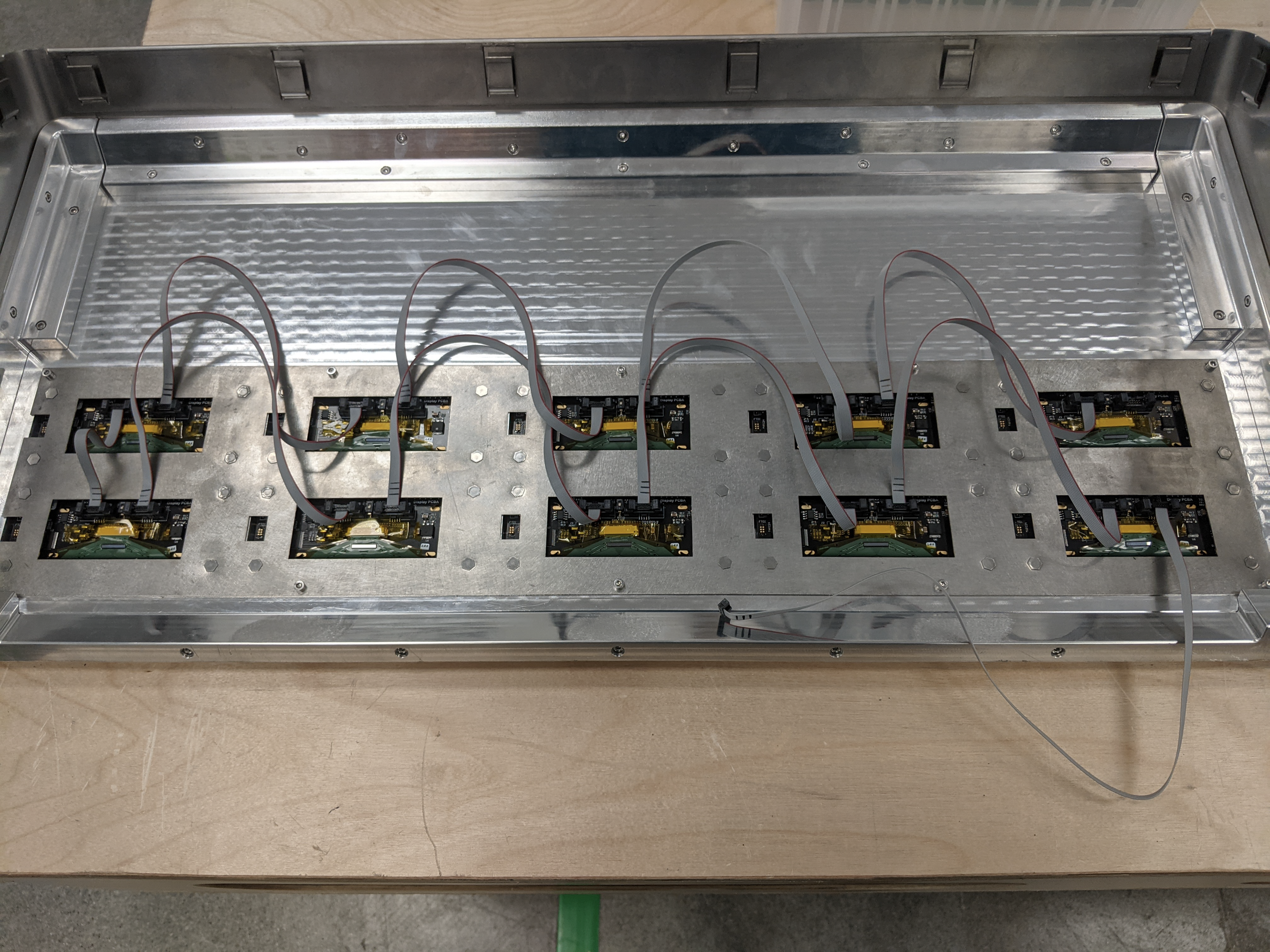
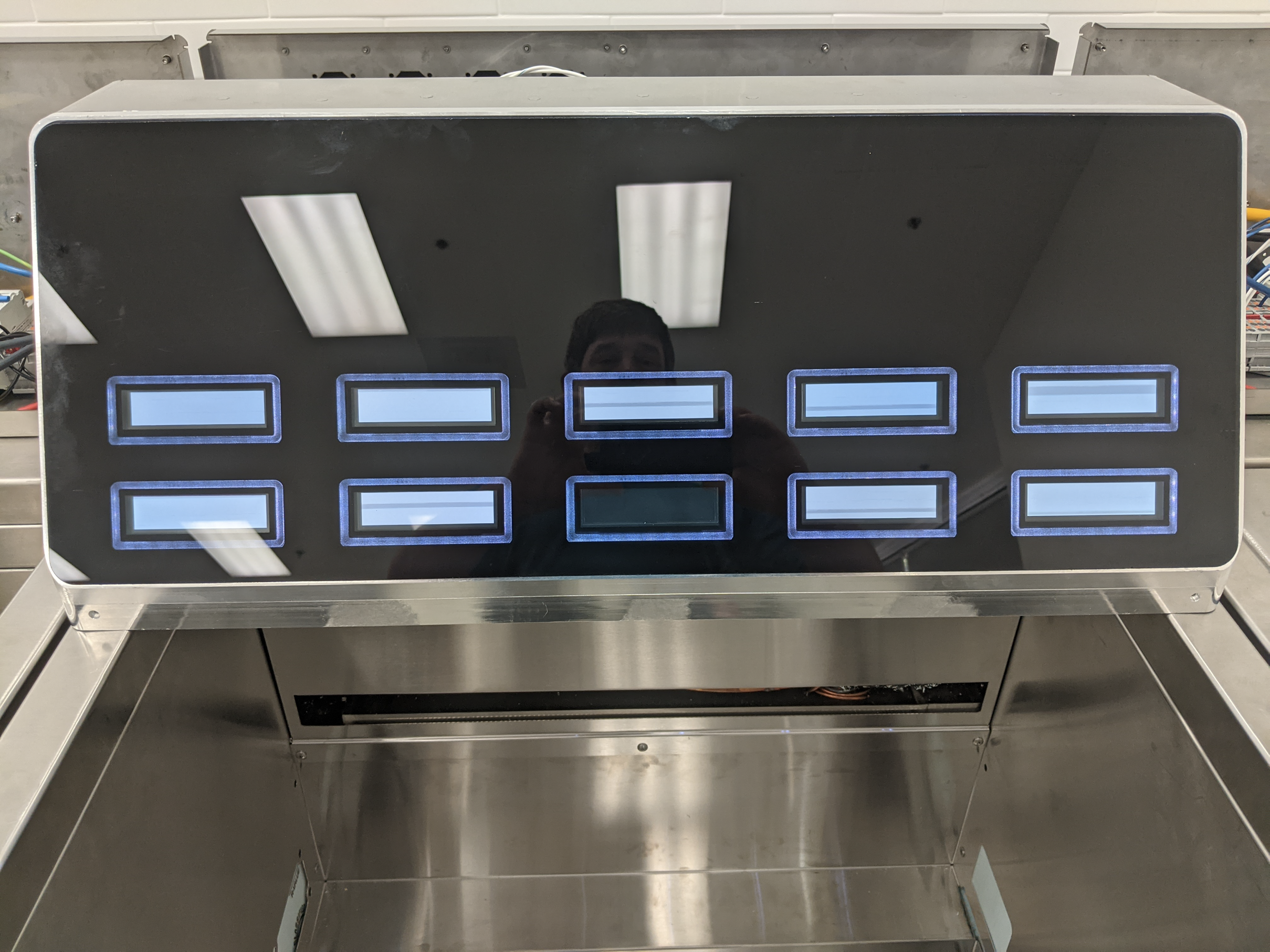
- Intervention: Built the backsplash into the optical nervous system: 256×64 OLED modules behind an 85%-opaque “dead front” polycarbonate (invisible when off), ringed by the Makelight — an LED grid behind a diffuser that visually nudges staff at the exact hopper location when an ingredient runs low or a manual step is due, synchronized with the gram-level inventory sensing below.
- Result: The empty-hopper failure state closed, manual finish work synchronized to automated precision, and cognitive load converted into glanceable light.
4. The Guacamole Trap
- Trigger: Standard HMI panels and cabinets carry raised bezels, exposed screws, and vents — organic-debris traps that violate NSF radius rules and blow the cleaning labor budget.
- Intervention: The “dead front” monolith: a sealed IP65 face with no external mechanical interfaces, no bezels, no exposed fasteners — designed so daily sanitation requires zero disassembly.
- Result: The backsplash cleans like an appliance surface in the system-wide 15-minute cycle, while the electronics behind it never see a sponge.
III. Governance & Rhythm
- The Pulse: A single Beckhoff industrial PC with TwinCAT core isolation segregating real-time motion from IoT data — making the “Friday night breakdown” (data load stalling actuation) structurally impossible — under the CulinaryOS / ServeOS software stack.
- The Artifacts: The display PCB dimensional control drawing (August 2021); the backsplash industrial-design specification (dead-front tint, lighted-bezel construction); the 10244R1 board photography; the patent’s infrastructure-slot airflow figures.
IV. Quantified Impact
- Cut control hardware volume ~50% via the EJ-module PCB backplane.
- Eliminated discrete wiring for 99% of signal distribution — and freed the airflow path in the same stroke.
- Consolidated 70+ actuator control signals onto a daisy-chained backplane array.
- Achieved IP65 enclosure protection with IP69K washdown-rated cooling.
- Enabled the 15-minute system sanitation cycle with a zero-disassembly control surface.
- Closed the human QA loop at 350 meals/hour through the Makelight interface.
V. Source Trail
The claims above rest on the project’s primary evidence archive — schematics, ID specifications, and build photography — compiled through the NotebookLM forensic registry:
DISPLAY_PCB_DCD_2021_08_25.pdf— the display interface dimensional control drawing.backsplash.pdf— “the PC Case”: open-chassis photography of the EJ modules and backplane array.Backsplash_ID.pdf— the dead-front polycarbonate and lighted-bezel specifications (NHD-3.12 OLED).makeline.pdf— the 10244R1 close-up (EtherCAT slave controller, motor-chain headers).04028VA_IP69K.pdf— the washdown-rated fan datasheet.- US20240164588A1 (Figure 8B) — the infrastructure-slot airflow architecture.